
The Veteran at the End of the Table
Nearly every board we serve has one. Here's why that matters, and seven ways to say thank you this Veterans Day.
It usually happens in a clubhouse.
Folding tables in a U. Coffee in a carafe that's been sitting a little too long. A stack of budget packets, a few owners in the back row, and a board working through the agenda one line item at a time.
And somewhere near the end of the table, there's someone who has been quietly taking notes the whole time. When the conversation gets heated about a reserve contribution, they're the one who brings it back to the plan. When a vendor misses a deadline, they're the one who already called. And later, over that same burnt coffee, you find out why: years in uniform. A deployment or two. A clearance they still can't talk much about.
I've had some version of that conversation more times than I can count. In the work we do at Ledgerly, sitting with HOA and condo boards across the country, it seems like nearly every board we serve has at least one veteran on it.
That's not a coincidence. And on Veterans Day, I think it's worth talking about.
By the numbers: fewer veterans, outsized impact
Here's the part that surprised me. Veterans are a shrinking share of the country.
According to Pew Research Center, there are about 18.3 million living veterans in the U.S., roughly 6% of adults. In 1980, it was about 18%. The VA projects the number will fall to about 12.1 million by 2048.
So if veterans are a smaller and smaller slice of the population, why do I keep meeting them at the end of the table?
The 2025 Veterans Civic Health Index, from We the Veterans and Military Families and the National Conference on Citizenship, has a big part of the answer:
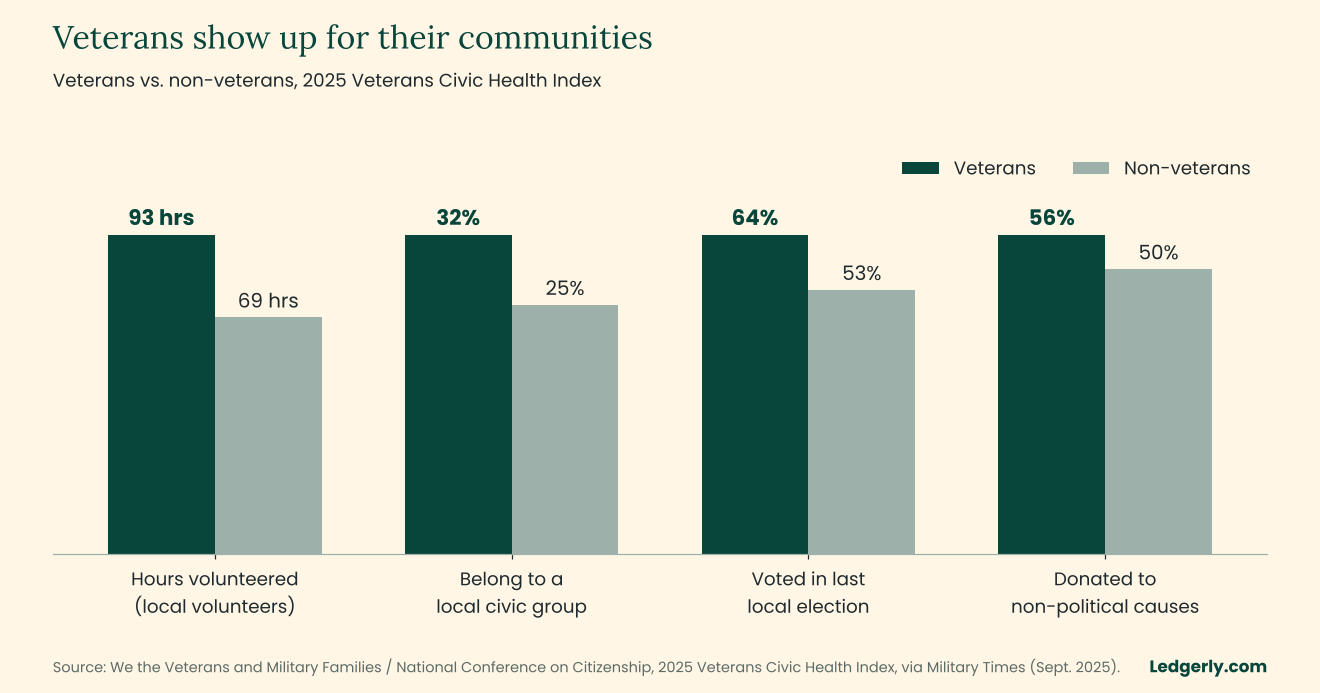 Source: 2025 Veterans Civic Health Index (We the Veterans and Military Families, National Conference on Citizenship), reported by Military Times, Sept. 2025.
- Hours volunteered (among those who volunteer locally): veterans 93 hours, non-veterans 69 hours
- Belong to a local civic group: veterans 32%, non-veterans 25%
- Voted in the last local election: veterans about 64%, non-veterans 53%
- Donated to non-political causes: veterans 56%, non-veterans 50%
Veterans volunteer at about the same rate as everyone else. But when they show up, they stay longer, they join, and they vote in the elections most of us skip. Local elections. Like, say, the one for your association board.
Takeaway: Veterans don't just serve once. A lot of them keep serving, a little closer to home.
The stories I get to hear
I want to be careful here, because these aren't my stories. They belong to the people who lived them.
But I'll tell you what it's like to be on the receiving end. You're walking through a budget with a board member, and the conversation drifts to where they were stationed. Someone talks about a deployment, what it was like to be that far from home, and what they missed while they were gone. Someone else mentions a top secret clearance, then smiles and changes the subject.
It's fascinating. It's also humbling.
Every one of those vignettes is a reminder of how much was asked of them, and how much they gave so the rest of us didn't have to. They put themselves in harm's way, often far from home, for people they would never meet. Then they came home, bought a condo or a house in a neighborhood like yours, and volunteered for the board.
It's an honor to spend time with them. Honestly, it's one of my favorite parts of the job.
Board service is service
I'm not going to pretend that serving on an HOA board is the same as serving in uniform. It isn't. Nobody is deploying over a landscaping contract.
But I think veterans recognize something in board service that the rest of us sometimes miss: it's a duty.
When you serve on a community association board, you're looking out for your friends and neighbors. You protect their interests. You make the unpopular call on reserves because you know the roof is coming. You show up to the meeting when it would be easier to stay home.
That's stewardship. It's the same instinct, at a much smaller scale and with far less at stake, that drives military service: take care of the people around you, and take care of the mission.
Takeaway: Veterans recognize a mission when they see one. Board service is a mission.
Salute to Service, NFL style
Every November, the NFL runs Salute to Service. You've seen the camouflage on the sidelines and the flyovers before kickoff. Since 2011, the program has raised more than $75 million for military nonprofits, including the USO, the Bob Woodruff Foundation, the Pat Tillman Foundation, TAPS and Wounded Warrior Project, according to the league.
I love it. But I also love the idea that you don't need a stadium to do your own version.
What if every community did a small Salute to Service this month? A thank-you at the next board meeting. A note in the newsletter. A table at the holiday party for veterans' stories. It costs almost nothing, and it means a lot.
Seven ways to honor and support veterans (starting this week)
Here's my list. Some of these are big, most are small, and all of them count.
- Say "thank you for your service": Simple, sincere, and always enough
- Ask for the story, then listen: Most veterans are rarely asked
- Pick up the tab: A quiet, generous gesture they remember
- Know the veteran discounts: Real savings, and a reason to say thanks
- Ask businesses about their policy: More companies have one than you think
- Support the posts and causes: Local impact, year-round
- Recognize the veterans on your own board: Service is happening in your clubhouse
1. Say thank you, and mean it
Any time you see a veteran, "thank you for your service" is enough. Look them in the eye. Shake their hand. Smile.
2. Ask for the story
If there's time, go one step further. Ask where they served, or how it shaped their life, or what they remember most. Then listen. Some will share a lot, some very little, and both are fine. You'll learn something either way.
3. Pick up the tab
If you're able, pick up their lunch or coffee. Tell the server it's on you. Then go shake their hand and say thanks. I promise you'll get more out of it than they will.
4. Know the discounts (and help veterans use them)
A lot of companies offer veteran discounts, and many veterans don't know about all of them. A few examples:
- The Home Depot offers a 10% military discount to eligible veterans, verified online, up to $400 a year.
- Alaska Airlines allows military veterans to pre-board, according to Military Money Manual's review of airline policies. Most airlines limit early boarding to active duty, so it's always worth checking.
- Restaurants, subscriptions and retailers often have programs, especially around Veterans Day.
5. Ask, even when there's no sign
Here's a story. Not long ago I was shopping at a Polo outlet in Colorado with my daughter's boyfriend, who served in the Marines. There was no sign at the register. We asked anyway. They honored a military discount on the spot.
The lesson: ask. More companies have a policy than advertise one, and asking is another small way to say "we see you."
6. Support the posts and the causes
The American Legion was founded in Paris in 1919 and has thousands of local posts across the country, many of them running events, scholarships, youth programs and fundraisers all year.
Over the years I've helped local posts with auction items: I donated a Clayton Kershaw jersey to one fundraiser, and I've reached out to local golf courses to ask for round certificates for others. Most businesses are happy to help when someone simply asks.
Find your local post, VFW or veterans' charity, and ask what they need. Time, items, sponsorships and attendance all count.
7. Recognize the veterans on your own board
Start in your own clubhouse. At your next board or annual meeting, thank the veterans who serve. Put a note in the newsletter. Ask if they'd share a few words at the holiday party.
They're already serving your community. Let them know you noticed.
So, who's at the end of your table?
Veterans are a smaller share of the country than ever, and they're still showing up for their communities more than almost anyone. That's worth more than a day on the calendar.
So here's my ask, and I'd love to hear how it goes:
- Who is the veteran at the end of your table?
- When did you last thank them?
- What's one question you could ask them this week?
Thank you to every veteran who served, and to every one of you who keeps serving, on a board, in a post, or just as a good neighbor. We're grateful.
Donald Nosek leads Commercial Development at Ledgerly, an association accounting service for HOA and condo boards. God bless our veterans and their families.
Sources
- Pew Research Center, "The changing face of America's veteran population," Nov. 8, 2023: pewresearch.org/short-reads/2023/11/08/the-changing-face-of-americas-veteran-population/
- 2025 Veterans Civic Health Index (We the Veterans and Military Families; National Conference on Citizenship), reported by Military Times, Sept. 11, 2025: militarytimes.com/news/pentagon-congress/2025/09/11/veterans-volunteer-longer-vote-more-often-than-civilian-peers-report/
- "NFL Salute to Service raises millions for its military nonprofit partners," FOX 13, Nov. 11, 2025: fox13news.com
- The Military Wallet, Home Depot military discount: themilitarywallet.com/home-depot-lowes-10-military-discount/
- Military Money Manual, "Airline Military Boarding Policies": militarymoneymanual.com/airline-military-boarding/
- Encyclopaedia Britannica, "American Legion": britannica.com/topic/American-Legion
- Photo: Linda Rusinko via Pexels (free license). Veterans Day card and chart: Ledgerly.